Disclosure: This post contains affiliate links. If you buy through them, I may earn a commission at no extra cost to you.
By mid-January, the air inside a heated house gets dry enough to feel. Static shocks off every doorknob, lips cracking, a wooden dresser drawer that suddenly sticks. A little bedroom humidifier fixes the room it sits in and does nothing for the rest of the house, and it still needs filling every day.
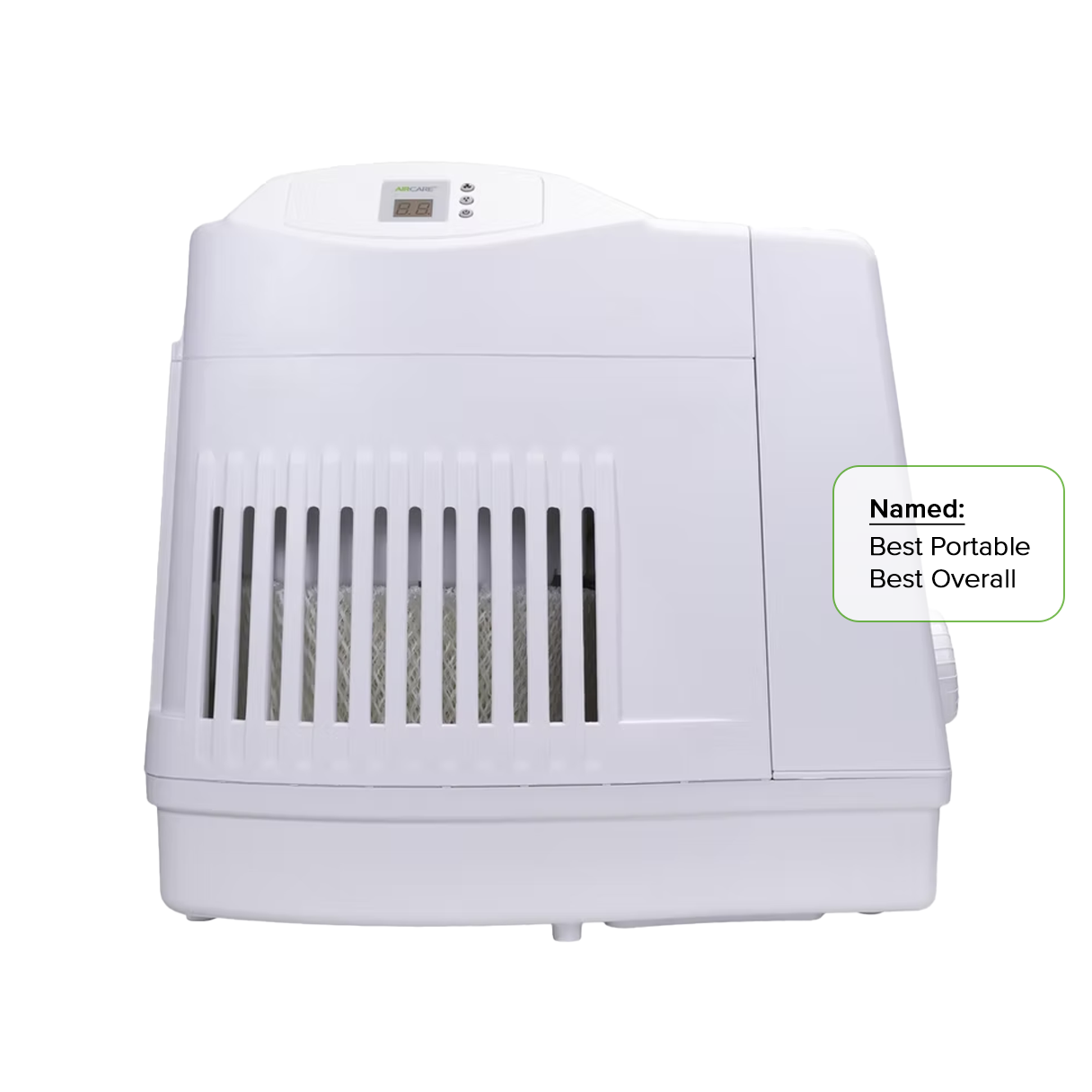
Whole house humidifiers are sold for exactly that gap, but most of them bolt onto a furnace and need a water line, a drain, and somebody comfortable cutting into ductwork. The AIRCARE MA1201 is the other kind. It’s a console on caster wheels that plugs into a normal outlet, holds 3.6 gallons, and claims to cover up to 3,600 square feet. I went through AIRCARE’s own manual and product pages, then owner reviews and long-form reviews of this unit, to work out where the claim holds up and where owners start grumbling.
The short version
The MA1201 is an evaporative console humidifier. A fan pulls dry air through a wet paper wick, the MAF1 SuperWick, and sends the moisture back out invisibly. AIRCARE rates it at up to 12 gallons of output a day and up to 3,600 square feet in a tightly built home, with a digital humidistat you can set between 25 and 65 percent. Owners rate it around 4.4 stars, and the pattern in the reviews is consistent: it does raise the humidity across a big open floor, and the price of that is upkeep. Wicks, refills, and cleaning are part of owning it. Check the current price on Amazon if that trade sounds fair.
Specs that matter, and what they mean
| Spec | AIRCARE MA1201 |
|---|---|
| Coverage | Up to 3,600 sq ft (tight construction, 8 ft ceilings) |
| Output | Up to 12 gallons per day |
| Water capacity | 3.6 gallons |
| Run time | Up to 36 hours per fill |
| Fan speeds | 4, plus an Auto mode |
| Humidistat | Digital, set 25 to 65 percent |
| Power draw | 80 watts |
| Wick | MAF1 SuperWick, replaced every 30 to 60 days |
| Warranty | 2 years on the unit, 30 days on wicks |
Two of those numbers need context. The output figure comes from the ANSI/AHAM HU-1 test in AIRCARE’s manual, and it’s the top fan speed running flat out. The coverage figure assumes a well-sealed house, and AIRCARE’s own footnote says results vary. A drafty older home leaks moisture to the outdoors all day, so the same machine covers less of it. Treat 3,600 square feet as the ceiling for a tight house, and you’ll have the right expectation.
The 36-hour run time needs the same treatment. That’s the maximum, at low output. At the top speed’s rated output, the tank’s water is gone in roughly seven hours of fan time. In practice the humidistat cycles the fan off once your setting is reached, so a fill lands somewhere between those two numbers. During a cold, dry snap, plan on filling it daily.
Where the moisture can actually reach
A console humidifier treats the air around it and relies on your home’s air movement to spread the moisture. AIRCARE’s manual suggests parking it near a cold air return, against an inside wall, a couple of inches clear of walls and curtains, on a hard flat floor. Follow that and an open-plan main floor is where this unit earns its keep. Kitchens, living areas, and hallways that flow into each other all pick up moisture.
Closed doors are the limit. A bedroom at the end of the hall with the door shut gets a fraction of what the living room gets, and a second floor gets less than the floor the unit sits on. That’s physics, and it applies to every console in this category. If your house is a row of small closed rooms, no single console will even them all out.
The wick is the running cost
Evaporative humidifiers have one consumable, and on the MA1201 it’s the MAF1 SuperWick. AIRCARE says to fit a new one at the start of every season and again after every 30 to 60 days of use, sooner if your water is hard. The company’s own store sells the wick at $26.99, or $68.99 for three. Indoor Air Review did the season arithmetic on a 150-day heating season and landed at roughly $94 to $160 all-in, counting three to five wicks plus the electricity for running it 12 hours a day. The machine itself sips power at 80 watts, so the wicks are nearly the whole bill.
Skipping wick changes is where owners get into trouble. An old wick puts out less and less water, and a wick left wet and dirty can start to smell. Everything Humidifiers’ summary of owner feedback flags the same thing: neglect the wick and you invite mold and a sour smell. AIRCARE also recommends its bacteriostat treatment at every refill, and the manual wants a proper clean at each wick change, a vinegar descale first and a bleach disinfect after, done as two separate steps. One more warning from that manual: only AIRCARE or Essick Air wicks keep the certified output rating. Cheaper third-party wicks can void it, and the warranty treats swapped wicks as an alteration.
There’s a fair trade buried in all this upkeep. Because the water evaporates out of a wick, the minerals in your tap water stay in the wick. You don’t get the white dust that ultrasonic humidifiers settle over furniture, and you can run it on plain tap water.
Noise, the cord sensor, and two setup traps
The lowest fan speed, F1, is the quiet one, and it’s what most owners run overnight. Push toward F4 and you’ll hear it. Owner reviews bring up fan noise on the higher speeds more than any other comfort complaint, and a smaller number report a unit turning loud within weeks, which is a warranty conversation. If the plan is to run it beside a sofa all evening, expect to live on the lower speeds and accept slower recovery after a dry day.
The humidity sensor doesn’t sit inside the cabinet. It’s on the power cord, so where the cord ends up changes what the machine thinks the room feels like. Tuck the cord behind the unit against a warm wall and the reading skews. Some owners report the built-in reading disagreeing with a standalone hygrometer by a wide margin, and the cord placement explains at least part of that. Keep the cord out in the open, away from heat sources, and sanity-check the display against a cheap hygrometer during the first week.
Two defaults catch new owners. The unit starts at a 65 percent set point, and at 65 percent it doesn’t cycle at all, it just runs continuously. Set a proper target before you walk away. Settings also reset to the defaults whenever the machine is unplugged or the power blips, so after an outage it quietly goes back to running nonstop. And filling it is a two-round job: the bottle drains into the base, then you fill and seat the bottle a second time to reach the full 3.6 gallons.
Console or furnace unit
The other way to humidify a whole house is a unit mounted on the furnace, and AprilAire’s models are the ones that top most roundups for that route. A furnace humidifier plumbs into a water line, fills itself, and pushes moisture through the ducts into every room, including the closed bedrooms a console can’t reach. The better AprilAire controls even watch the outdoor temperature and lower the target on their own during a cold snap, which is the standard fix for fogged windows.
It costs more than this console before anyone installs it, and it only works if your home has forced-air heat. Renters can’t fit one. Neither can homes on boilers, radiators, or mini-splits. The MA1201 exists for those houses, and for anyone who’d rather roll a box into the corner than pay an HVAC bill. I wouldn’t buy this unless the furnace route is closed to you, or the installation cost kills it. If you own a forced-air home and plan to stay in it for years, the plumbed unit is the better long-term buy, and it isn’t close.
Who should buy it, and who should skip it
Buy it for an open-plan home, a rental, or any house without ductwork, where dry winter air is a whole-floor problem. Buy it if your water is hard, since the wick handles minerals that would choke an ultrasonic unit. Skip it for a single bedroom, where it’s a 20-inch box doing a small room’s job. Skip it if you know you won’t change a wick every month or two, because a neglected MA1201 slowly turns into a weak, smelly one. And skip it if your house is large and leaky and you’re expecting the full 3,600 square feet on the box. That number belongs to tight houses.
AIRCARE MA1201 FAQs
Can a console humidifier really humidify a whole house?
Up to a point. The MA1201 is rated for up to 3,600 square feet in a tightly built home with 8-foot ceilings, and it does best on one open floor. Closed-off rooms and other floors get noticeably less, because the moisture travels on your home’s air movement.
How long does it run on one fill?
Up to 36 hours at low output. At the top fan speed the rated output would empty the tank in about seven hours of running, and the humidistat cycling stretches what you actually get between the two. In a cold, dry spell, expect to fill it most days.
How often do I change the wick, and what does it cost?
At the start of each season and every 30 to 60 days of use, sooner with hard water. AIRCARE sells the MAF1 SuperWick for $26.99, or $68.99 for a three-pack, so a full heating season usually takes three to five wicks.
Will it leave white dust on my furniture?
No. It’s an evaporative unit, so the minerals in tap water stay trapped in the wick instead of being thrown into the air. The wick changes are the price of that benefit.
What humidity should I set it to in winter?
AIRCARE suggests starting at 30 to 40 percent and lowering the target as it gets colder outside, down to 15 to 20 percent at minus 20°F, and keeping indoor humidity under 50 percent. If condensation shows up on your windows, the setting is too high for the weather. Turn it down until the glass stays clear.
My final take
The MA1201 is an old design that keeps selling because it solves the problem for the houses the furnace units can’t touch. It asks for wicks, refills, and the odd cleaning session in return. If that rhythm sounds manageable, it’s the console I’d put in an open-plan home this winter. See the AIRCARE MA1201 on Amazon.
Leave a Reply